<?xml version="1.0" encoding="iso-8859-1"?>
<!DOCTYPE html PUBLIC
    "-//W3C//DTD XHTML 1.1 plus MathML 2.0 plus SVG 1.1//EN"
    "http://www.w3.org/2002/04/xhtml-math-svg/xhtml-math-svg-flat.dtd">
<html xmlns="http://www.w3.org/1999/xhtml" xml:lang="en" dir="ltr">


<head>
<meta http-equiv="Content-Type" content="text/html; charset=iso-8859-1" />
<title>Mécanique - Introduction à la mécanique classique</title>
<link rel="stylesheet" type="text/css" media="screen" title="cours" href="cours.css" />
<link rel="alternate stylesheet" type="text/css" media="screen"  title="plan" href="plan.css" />

</head>


<body >
<div id="page">
<h1>Introduction à la mécanique classique - Rappels et domaine de validité</h1>
<hr />
<p><em>Les vecteurs sont notés en gras.</em></p>


<h2>Première loi de Newton ou principe d'inertie</h2>
<p class="def">Dans un référentiel galiléen, un point matériel isolé à un
mouvement rectiligne uniforme.</p>
<p>Qu'est-ce qu'un <strong>mouvement rectiligne uniforme</strong> ?
<em>Un mouvement rectiligne uniforme est un mouvement pour
lequel</em> <math xmlns="http://www.w3.org/1998/Math/MathML" overflow="scroll">
    <mi mathvariant="bold">v</mi>
    <mo>=</mo>
    <mi mathvariant="bold">cte</mi>
  </math></p>
<p>direction constante <math xmlns="http://www.w3.org/1998/Math/MathML" overflow="scroll">
    <mo>&#x2192;</mo>
  </math> rectiligne</p>
<p>norme constante <math xmlns="http://www.w3.org/1998/Math/MathML" overflow="scroll">
    <mo>&#x2192;</mo>
  </math> uniforme</p>
<p>immobilité cas particulier <math xmlns="http://www.w3.org/1998/Math/MathML"  overflow="scroll">
    <mi mathvariant="bold">v</mi>
    <mo>=</mo>
    <mn mathvariant="bold">0</mn>
  </math></p>


<p>Qu'est-ce qu'un <strong>point matériel isolé</strong> ? <em>
C'est un point affecté d'une masse qui n'est soumis à aucune
force</em>.</p>
<p>C'est une situation idéale car un objet est toujours soumis à des
forces, ces forces pouvant éventuellement être négligeables ou se
compenser; on parle alors d'objet <strong>pseudo-isolé</strong>.</p>

<p>Qu'est-ce qu'un <strong>référentiel</strong> ?</p>
<p>Un référentiel va nous permettre de répondre aux questions où ? et
quand ? En effet, pour décrire un mouvement, il faut pouvoir
préciser à la fois où se trouve le point et à quel instant il s'y
trouve. Pour préciser où se trouve le point, on utilisera un
<strong>repère</strong> et pour préciser à quel instant il s'y trouve, on
utilisera une <strong>horloge</strong> :</p>
<p><em>référentiel = repère + horloge</em></p>

<p>Qu'est-ce qu'un référentiel <strong>galiléen</strong> ?<em>
Un référentiel galiléen est un référentiel dans lequel un point
matériel isolé à un mouvement rectiligne uniforme</em>.</p>
<p>Seule l'expérience pourra nous dire si un référentiel est galiléen
ou pas.</p>


<h2>Deuxième loi de Newton ou principe fondamental de la dynamique</h2>
<h3>Enoncé</h3>
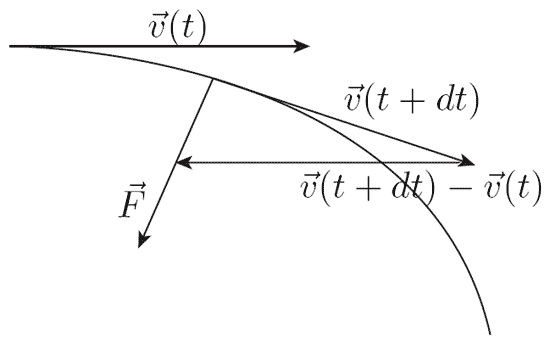
<p>Le mouvement est donc modifié par les forces. Un mouvement
est modifié si la direction du vecteur vitesse et/ou sa norme varie
 <math xmlns="http://www.w3.org/1998/Math/MathML" overflow="scroll">
    <mi mathvariant="bold">v</mi>
    <mo>&#x2260;</mo>
    <mi mathvariant="bold">cte</mi>
  </math> ou
encore <math xmlns="http://www.w3.org/1998/Math/MathML" overflow="scroll">
    <mi mathvariant="bold">a</mi>
    <mo>&#x2260;</mo>
    <mn mathvariant="bold">0</mn>
  </math> puisque</p>
<math xmlns="http://www.w3.org/1998/Math/MathML" display="block" overflow="scroll">
    <mi mathvariant="bold">a</mi>
    <mo>=</mo>
    <mstyle displaystyle="true">
      <mfrac>
        <mrow>
          <mi>d</mi>
          <mi mathvariant="bold">v</mi>
        </mrow>
        <mrow>
          <mi>d</mi>
          <mi>t</mi>
        </mrow>
      </mfrac>
    </mstyle>
  </math>
<p>où <math xmlns="http://www.w3.org/1998/Math/MathML" overflow="scroll">
    <mi>d</mi>
    <mi mathvariant="bold">v</mi>
    <mo>=</mo>
    <mi mathvariant="bold">v</mi>
    <mo>&#x2061;</mo>
    <mfenced separators="">
      <mi>t</mi>
      <mo>+</mo>
      <mrow>
        <mi>d</mi>
       <mi>t</mi>
      </mrow>
    </mfenced>
    <mo>-</mo>
    <mi mathvariant="bold">v</mi>
    <mo>&#x2061;</mo>
    <mfenced>
      <mi>t</mi>
    </mfenced>
  </math> est la variation
infinitésimale du vecteur vitesse entre les instants <math xmlns="http://www.w3.org/1998/Math/MathML" overflow="scroll">
    <mi>t</mi>
  </math> et
<math xmlns="http://www.w3.org/1998/Math/MathML" overflow="scroll">
    <mi>t</mi>
    <mo>+</mo>
    <mrow>
      <mi>d</mi>
      <mi>t</mi>
    </mrow>
  </math>.</p>
<p>La deuxième loi de Newton est la relation entre la modification du mouvement (accélération) et sa cause (force) : </p>
<p class="def">Dans un référentiel galiléen <math xmlns="http://www.w3.org/1998/Math/MathML" overflow="scroll">
    <mi>m</mi>
    <mi mathvariant="bold">a</mi>
    <mo>=</mo>
    <mi mathvariant="bold">F</mi>
  </math></p>

<div class="centre"><img src="images/mecanique_deuxieme_loi.png" alt="" /></div>

<p>où <math xmlns="http://www.w3.org/1998/Math/MathML" overflow="scroll">
    <mi mathvariant="bold">F</mi>
  </math> est la résultante des forces appliquées au point
matériel de masse <math xmlns="http://www.w3.org/1998/Math/MathML" overflow="scroll">
    <mi>m</mi>
  </math> dont l'accélération est <math xmlns="http://www.w3.org/1998/Math/MathML" overflow="scroll">
    <mi mathvariant="bold">a</mi>
  </math>.</p>
<p>Le principe d'inertie est le cas particulier du principe
fondamental</p>
<math xmlns="http://www.w3.org/1998/Math/MathML" display="block" overflow="scroll">
    <mi mathvariant="bold">F</mi>
    <mo>=</mo>
    <mn>0</mn>
    <mo>&#x21D2;</mo>
    <mi mathvariant="bold">a</mi>
    <mo>=</mo>
    <mn>0</mn>
    <mo>&#x21D2;</mo>
    <mi mathvariant="bold">v</mi>
    <mo>=</mo>
    <mi mathvariant="bold">cte</mi>
  </math>
<p>La masse (inertielle) est donc un coefficient de proportionnalité;
pour <math xmlns="http://www.w3.org/1998/Math/MathML" overflow="scroll">
    <mi mathvariant="bold">F</mi>
  </math> donnée, la modification du mouvement est
d'autant plus grande que <math xmlns="http://www.w3.org/1998/Math/MathML" overflow="scroll">
    <mi>m</mi>
  </math> est petit (il est plus facile de
modifier le mouvement d'un vélo que celui d'un camion !).</p>


<h3>Exploitation</h3>
<h4>Solution analytique</h4>
<p>Etudions le mouvement d'un projectile de masse <math xmlns="http://www.w3.org/1998/Math/MathML" overflow="scroll">
    <mi>m</mi>
  </math>
lancée avec une vitesse initiale <math xmlns="http://www.w3.org/1998/Math/MathML" overflow="scroll">
    <msub>
      <mi mathvariant="bold">v</mi>
      <mn>0</mn>
    </msub>
  </math> dans le champ de pesanteur terrestre (on négligera les frottements)</p>
<p>Système étudié : projectile assimilable à un point
matériel de masse <math xmlns="http://www.w3.org/1998/Math/MathML" overflow="scroll">
    <mi>m</mi>
  </math></p>
<p>Référentiel : repère Oxyz (classe) supposé galiléen +
horloge (on l'oublie souvent car le temps est universel en
mécanique classique).</p>
<p>Bilan des forces : poids</p>
<p>Loi fondamentale : <math xmlns="http://www.w3.org/1998/Math/MathML" overflow="scroll">
    <mi>m</mi>
    <mi mathvariant="bold">a</mi>
    <mo>=</mo>
    <mi>m</mi>
    <mi mathvariant="bold">g</mi>
  </math></p>
<p>Projection :</p>
<math xmlns="http://www.w3.org/1998/Math/MathML" display="block" overflow="scroll">
    <mfenced close="" open="&#x2223;">
      <mtable columnalign="left">
        <mtr>
          <mtd>
            <msub>
              <mi>a</mi>
              <mi>x</mi>
            </msub>
          </mtd>
        </mtr>
        <mtr>
          <mtd>
            <msub>
              <mi>a</mi>
              <mi>y</mi>
            </msub>
          </mtd>
        </mtr>
        <mtr>
          <mtd>
            <msub>
              <mi>a</mi>
              <mi>z</mi>
            </msub>
          </mtd>
        </mtr>
      </mtable>
    </mfenced>
    <mo>=</mo>
    <mfenced close="" open="&#x2223;">
      <mtable columnalign="left">
        <mtr>
          <mtd>
            <mn>0</mn>
          </mtd>
        </mtr>
        <mtr>
          <mtd>
            <mo>-</mo>
            <mi>g</mi>
          </mtd>
        </mtr>
        <mtr>
          <mtd>
            <mn>0</mn>
          </mtd>
        </mtr>
      </mtable>
    </mfenced>
  </math>
<p>ce qui donne après intégration :</p>
<math xmlns="http://www.w3.org/1998/Math/MathML" display="block" overflow="scroll">
    <mi>y</mi>
    <mo>=</mo>
    <mo>-</mo>
    <mfrac>
      <mi>g</mi>
      <mrow>
        <mn>2</mn>
        <msubsup>
          <mi>v</mi>
          <msub>
            <mn>0</mn>
            <mi>x</mi>
          </msub>
          <mn>2</mn>
        </msubsup>
      </mrow>
    </mfrac>
    <msup>
      <mi>x</mi>
      <mn>2</mn>
    </msup>
    <mo>+</mo>
    <mstyle displaystyle="true">
      <mfrac>
        <msub>
          <mi>v</mi>
          <msub>
            <mn>0</mn>
            <mi>y</mi>
          </msub>
        </msub>
        <msub>
          <mi>v</mi>
          <msub>
            <mn>0</mn>
            <mi>x</mi>
          </msub>

        </msub>
      </mfrac>
    </mstyle>
    <mi>x</mi>
  </math>
<p>C'est une <strong>solution analytique</strong>, on a une fonction
mathématique qui nous donne tous les points de la trajectoire.<br />
Lorsqu'il n'existe pas de solution analytique on a recours à des
méthodes numériques où l'on calcule chaque point de la
trajectoire.</p>


<h4>Solution numérique</h4>
<p>cf TP</p>


<h3>Peut-on résoudre n'importe quel problème ?</h3>
<p>Les problèmes qui ont une solution analytique sont rares
et correspondent souvent à des situations idéales.<br />
La résolution numérique est toujours possible encore faut-il que
la deuxième loi de Newton puisse s'appliquer au problème.<br />
Plusieurs fois dans l'histoire, on a cru trouver des situations
remettant en cause cette loi et plusieurs fois le problème fut
résolu. <br />
Exemple : en fait le mouvement d'une planète autour du Soleil
n'est pas vraiment une ellipse mais on peut trouver les
corrections en tenant compte de l'attraction des autres planètes.
A l'époque, on a fait ces calculs et çà marchait sauf pour Uranus.
Le Verrier (1811-1877) eu l'idée d'attribuer la différence
observée à une planète invisible. On calcula la position de cette
planète invisible, on pointa un télescope dans la direction
calculée, la planète était là (Neptune)! Ce fut un grand succès
pour la deuxième loi.<br />
Pendant longtemps on cru que seuls une analyse incomplète ou des
calculs trop lourds pouvaient mettre en défaut la deuxième loi.<br />
Or même en tenant de toutes les forces et avec une capacité de calcul illimitée, il y a des domaines où la deuxième loi ne s'applique pas :</p>
<p class="def">domaine microscopique <math xmlns="http://www.w3.org/1998/Math/MathML" overflow="scroll">
    <mo>&#x2192;</mo>
  </math> mécanique quantique<br />
domaine <math xmlns="http://www.w3.org/1998/Math/MathML" overflow="scroll">
    <mi>v</mi>
    <mo>&#x2243;</mo>
    <mi>c</mi>
  </math> <math xmlns="http://www.w3.org/1998/Math/MathML" overflow="scroll">
    <mo>&#x2192;</mo>
  </math>
 relativité</p>


<h2>Troisième loi de Newton ou principe de l'action et de la réaction</h2>
<h3>Enoncé</h3>
<p class="def">Les forces d'interaction réciproque qui s'exercent entre
deux points matériels sont opposées et ont pour support la droite
joignant ces points.</p>


<h3>Une conséquence</h3>
<p>Le principe d'inertie ou la deuxième loi de Newton s'applique à un point matériel. Pourquoi peut-on l'appliquer à une planète par exemple ?</p>

<p>On "découpe" la planète en morceaux assez petits pour pouvoir les
considérer comme des points matériels de masse <math xmlns="http://www.w3.org/1998/Math/MathML" overflow="scroll">
    <msub>
      <mi>m</mi>
      <mi>i</mi>
    </msub>
  </math> tels que
<math xmlns="http://www.w3.org/1998/Math/MathML" overflow="scroll">
    <munder>
      <mo>&#x2211;</mo>
      <mi>i</mi>
    </munder>
    <msub>
      <mi>m</mi>
      <mi>i</mi>
    </msub>
    <mo>=</mo>
    <mi>m</mi>
  </math> masse de la planète. On peut alors appliquer la
deuxième loi à chaque point :</p>

<p><math xmlns="http://www.w3.org/1998/Math/MathML" overflow="scroll">
    <msub>
      <mi>m</mi>
      <mi>i</mi>
    </msub>
    <msub>
      <mi mathvariant="bold">a</mi>
      <mi>i</mi>
    </msub>
    <mo>=</mo>
  </math> forces exercées par les autres points (forces intérieures) + les autres forces (forces extérieures)</p>
<math xmlns="http://www.w3.org/1998/Math/MathML" display="block" overflow="scroll">
    <msub>
      <mi>m</mi>
      <mi>i</mi>
    </msub>
    <msub>
      <mi mathvariant="bold">a</mi>
      <mi>i</mi>
    </msub>
    <mo>=</mo>
    <munder>
      <mo>&#x2211;</mo>
      <mrow>
        <mi>j</mi>
        <mo>&#x2260;</mo>
        <mi>i</mi>
      </mrow>
    </munder>
    <msub>
      <mi mathvariant="bold">f</mi>
      <mrow>
        <mi>j</mi>
        <mo>&#x2192;</mo>
        <mi>i</mi>
      </mrow>
    </msub>
    <mo>+</mo>
    <msub>
      <mi mathvariant="bold">f</mi>
      <mrow>
        <mrow>
          <mi>e</mi>
          <mi>x</mi>
          <mi>t</mi>
        </mrow>
        <mo>&#x2192;</mo>
        <mi>i</mi>
      </mrow>
    </msub>
  </math>
<math xmlns="http://www.w3.org/1998/Math/MathML" display="block" overflow="scroll">
    <munder>
      <mo>&#x2211;</mo>
      <mi>i</mi>
    </munder>
    <msub>
      <mi>m</mi>
      <mi>i</mi>
    </msub>
    <msub>
      <mi mathvariant="bold">a</mi>
      <mi>i</mi>
    </msub>
    <mo>=</mo>
    <munder>
      <mo>&#x2211;</mo>
      <mi>i</mi>
    </munder>
    <munder>
      <mo>&#x2211;</mo>
      <mrow>
        <mi>j</mi>
        <mo>&#x2260;</mo>
        <mi>i</mi>
      </mrow>
    </munder>
    <msub>
      <mi mathvariant="bold">f</mi>
      <mrow>
        <mi>j</mi>
        <mo>&#x2192;</mo>
        <mi>i</mi>
      </mrow>
    </msub>
    <mo>+</mo>
    <munder>
      <mo>&#x2211;</mo>
      <mi>i</mi>
    </munder>
    <msub>
      <mi mathvariant="bold">f</mi>
      <mrow>
        <mrow>
          <mi>e</mi>
          <mi>x</mi>
          <mi>t</mi>
        </mrow>
        <mo>&#x2192;</mo>
        <mi>i</mi>
      </mrow>
    </msub>
  </math>
<math xmlns="http://www.w3.org/1998/Math/MathML" display="block" overflow="scroll">
    <mo>=</mo>
    <mn>0</mn>
    <mo>+</mo>
    <msub>
      <mi mathvariant="bold">F</mi>
      <mrow>
        <mrow>
          <mi>e</mi>
          <mi>x</mi>
          <mi>t</mi>
        </mrow>
        <mo>&#x2192;</mo>
        <mi>planete</mi>
      </mrow>
    </msub>
  </math>
<p>Vérifier pour <math xmlns="http://www.w3.org/1998/Math/MathML" overflow="scroll">
    <mi>i</mi>
    <mo>=</mo>
    <mn>3</mn>
  </math> par exemple</p>
<math xmlns="http://www.w3.org/1998/Math/MathML" display="block" overflow="scroll">
    <munder>
      <mo>&#x2211;</mo>
      <mi>i</mi>
    </munder>
    <msub>
      <mi>m</mi>
      <mi>i</mi>
    </msub>
    <msub>
      <mi mathvariant="bold">a</mi>
      <mi>i</mi>
    </msub>
    <mo>=</mo>
    <munder>
      <mo>&#x2211;</mo>
      <mi>i</mi>
    </munder>
    <msub>
      <mi>m</mi>
      <mi>i</mi>
    </msub>
    <mstyle displaystyle="true">
      <mfrac>
        <mrow>
          <msup>
            <mi>d</mi>
            <mn>2</mn>
          </msup>
          <msub>
            <mi mathvariant="bold">OM</mi>
            <mi>i</mi>
          </msub>
        </mrow>
        <mrow>
          <mi>d</mi>
          <msup>
            <mi>t</mi>
            <mn>2</mn>
          </msup>
        </mrow>
      </mfrac>
    </mstyle>
    <mo>=</mo>
    <mstyle displaystyle="true">
      <mfrac>
        <msup>
          <mi>d</mi>
          <mn>2</mn>
        </msup>
        <mrow>
          <mi>d</mi>
          <msup>
            <mi>t</mi>
            <mn>2</mn>
          </msup>
        </mrow>
      </mfrac>
    </mstyle>
    <munder>
      <mo>&#x2211;</mo>
      <mi>i</mi>
    </munder>
    <msub>
      <mi>m</mi>
      <mi>i</mi>
    </msub>
    <msub>
      <mi mathvariant="bold">OM</mi>
      <mi>i</mi>
    </msub>
    <mo>=</mo>
    <mstyle displaystyle="true">
      <mfrac>
        <msup>
          <mi>d</mi>
          <mn>2</mn>
        </msup>
        <mrow>
          <mi>d</mi>
          <msup>
            <mi>t</mi>
            <mn>2</mn>
          </msup>
        </mrow>
      </mfrac>
    </mstyle>
    <mi>m</mi>
    <mi mathvariant="bold">OG</mi>
    
  </math>
<math xmlns="http://www.w3.org/1998/Math/MathML" display="block" overflow="scroll">  
  <mo>=</mo>
    <mi>m</mi>
    <mi mathvariant="bold">a</mi>
    <mo>&#x2061;</mo>
    <mfenced>
      <mi>G</mi>
    </mfenced>
</math>
<p>Quand on assimile un système à un point matériel, on étudie en
fait le mouvement d'un point particulier appelé barycentre ou
centre d'inertie ou centre de gravité et on ne tient compte que
des forces extérieures au système.</p>


<div id="pied">
<hr />
<a href="../index.htm">accueil</a> >
<a href="../cours_de_physique.htm">matières</a> >
<a href="../cours_de_physique_rubriques/mecanique.htm">mécanique</a> > introduction à la mécanique classique


<div id="xiti-logo">
<a href="http://www.xiti.com/xiti.asp?s=284918" title="WebAnalytics">
<script type="text/javascript">
<!--
Xt_param = 's=284918&p=mecanique_introduction_mecanique_classique';
try {Xt_r = top.document.referrer;}
catch(e) {Xt_r = document.referrer; }
Xt_h = new Date();
Xt_i = '<img width="39" height="25" border="0" ';
Xt_i += 'src="http://logv8.xiti.com/hit.xiti?'+Xt_param;
Xt_i += '&hl='+Xt_h.getHours()+'x'+Xt_h.getMinutes()+'x'+Xt_h.getSeconds();
if(parseFloat(navigator.appVersion)>=4)
{Xt_s=screen;Xt_i+='&r='+Xt_s.width+'x'+Xt_s.height+'x'+Xt_s.pixelDepth+'x'+Xt_s.colorDepth;}
document.write(Xt_i+'&ref='+Xt_r.replace(/[<>"]/g, '').replace(/&/g, '$')+'">');
//-->
</script>
<object>
<noscript>
<div id="xiti-logo-noscript">
<img width="39" height="25" src="http://logv8.xiti.com/hit.xiti?s=284918&amp;p=&amp;" alt="WebAnalytics" />
</div>
</noscript>
</object>
</a>
</div>


</div><!-- pied -->


</div>
<!-- page -->
</body>
</html>