<?xml version="1.0" encoding="iso-8859-1"?>
<!DOCTYPE html PUBLIC
    "-//W3C//DTD XHTML 1.1 plus MathML 2.0 plus SVG 1.1//EN"
    "http://www.w3.org/2002/04/xhtml-math-svg/xhtml-math-svg-flat.dtd">
<html xmlns="http://www.w3.org/1999/xhtml" xml:lang="en" dir="ltr">


<head>
<meta http-equiv="Content-Type" content="text/html; charset=iso-8859-1" />
<title>Mécanique - Dynamique du point matériel en référentiel galiléen (suite)</title>
<link rel="stylesheet" type="text/css" media="screen" title="cours" href="cours.css" />
<link rel="alternate stylesheet" type="text/css" media="screen"  title="plan" href="plan.css" />

</head>


<body >
<div id="page">
<h1>Dynamique du point matériel en référentiel galiléen (suite)</h1>
<hr />
<p><em>Les vecteurs sont notés en gras.</em></p>


<h2>Moment cinétique</h2>
<p>Soit, dans un référentiel <math xmlns="http://www.w3.org/1998/Math/MathML" overflow="scroll">
    <mi>&#x211B;</mi>
  </math>, un point matériel M de masse <math xmlns="http://www.w3.org/1998/Math/MathML" overflow="scroll">
    <mi>m</mi>
  </math>, de vecteur vitesse <math xmlns="http://www.w3.org/1998/Math/MathML" overflow="scroll">
    <mi mathvariant="bold">v</mi>
  </math> et  <math xmlns="http://www.w3.org/1998/Math/MathML" overflow="scroll">
    <mi mathvariant="bold">F</mi>
  </math> la résultante des forces appliquées en M.<br />
Soit O un autre point de <math xmlns="http://www.w3.org/1998/Math/MathML" overflow="scroll">
    <mi>&#x211B;</mi>
  </math>.</p>

<h3>Définitions</h3>
<p>La grandeur</p>

<math xmlns="http://www.w3.org/1998/Math/MathML" display="block" overflow="scroll">
    <mtable frame="solid">
      <mtr>
        <mtd>
          <msub>
            <mi mathvariant="bold">L</mi>
            <mi>O</mi>
          </msub>
          <mo>=</mo>
          <mi mathvariant="bold">OM</mi>
          <mo>&#x2227;</mo>
          <mi>m</mi>
          <mi mathvariant="bold">v</mi>
        </mtd>
      </mtr>
    </mtable>
  </math>

<p>est appelée <strong>moment cinétique en O</strong> du point M.</p>

<p>La grandeur</p>

 <math xmlns="http://www.w3.org/1998/Math/MathML" display="block" overflow="scroll">
    <mtable frame="solid">
      <mtr>
        <mtd>
          <msub>
            <mi mathvariant="bold">&#x2133;</mi>
            <mi>O</mi>
          </msub>
          <mo>=</mo>
          <mi mathvariant="bold">OM</mi>
          <mo>&#x2227;</mo>
          <mi mathvariant="bold">F</mi>
        </mtd>
      </mtr>
    </mtable>
  </math>

<p>est appelée <strong>moment en O</strong> de la résultante des forces  <math xmlns="http://www.w3.org/1998/Math/MathML" overflow="scroll">
    <mi mathvariant="bold">F</mi>
  </math> appliquée au point M.</p>


<h3>Théorème du moment cinétique en un point fixe</h3>
<p>Soit O un point <strong>fixe</strong> d'un référentiel <strong>galiléen</strong> <math xmlns="http://www.w3.org/1998/Math/MathML" overflow="scroll">
    <mi>&#x211B;</mi>
  </math> :</p>

<math xmlns="http://www.w3.org/1998/Math/MathML" display="block" overflow="scroll">
    <mstyle displaystyle="true">
      <mfrac>
        <mrow>
          <mi>d</mi>
          <msub>
            <mi mathvariant="bold">L</mi>
            <mi>O</mi>
          </msub>
        </mrow>
        <mrow>
          <mi>d</mi>
          <mi>t</mi>
        </mrow>
      </mfrac>
    </mstyle>
    <mo>=</mo>
    <mstyle displaystyle="true">
      <mfrac>
        <mrow>
          <mi>d</mi>
          <mi mathvariant="bold">OM</mi>
        </mrow>
        <mrow>
          <mi>d</mi>
          <mi>t</mi>
        </mrow>
      </mfrac>
    </mstyle>
    <mo>&#x2227;</mo>
    <mi>m</mi>
    <mi mathvariant="bold">v</mi>
    <mo>+</mo>
    <mi mathvariant="bold">OM</mi>
    <mo>&#x2227;</mo>
    <mi>m</mi>
    <mstyle displaystyle="true">
      <mfrac>
        <mrow>
          <mi>d</mi>
          <mi mathvariant="bold">v</mi>
        </mrow>
        <mrow>
          <mi>d</mi>
          <mi>t</mi>
        </mrow>
      </mfrac>
    </mstyle>
    <mo>=</mo>
    <mn mathvariant="bold">0</mn>
    <mo>+</mo>
    <mi mathvariant="bold">OM</mi>
    <mo>&#x2227;</mo>
    <mi>m</mi>
    <mi mathvariant="bold">a</mi>
  </math>

<p>la deuxième loi de Newton donne :</p>
<math xmlns="http://www.w3.org/1998/Math/MathML" display="block" overflow="scroll">
    <mstyle displaystyle="true">
      <mfrac>
        <mrow>
          <mi>d</mi>
          <msub>
            <mi mathvariant="bold">L</mi>
            <mi>O</mi>
          </msub>
        </mrow>
        <mrow>
          <mi>d</mi>
          <mi>t</mi>
        </mrow>
      </mfrac>
    </mstyle>
    <mo>=</mo>
    <mi mathvariant="bold">OM</mi>
    <mo>&#x2227;</mo>
    <mi mathvariant="bold">F</mi>
  </math>

<p>d'où le théorème du moment cinétique :</p>

<math xmlns="http://www.w3.org/1998/Math/MathML" display="block" overflow="scroll">
    <mtable frame="solid">
      <mtr>
        <mtd>
          <mstyle displaystyle="true">
            <mfrac>
              <mrow>
                <mi>d</mi>
                <msub>
                  <mi mathvariant="bold">L</mi>
                  <mi>O</mi>
                </msub>
              </mrow>
              <mrow>
                <mi>d</mi>
                <mi>t</mi>
              </mrow>
            </mfrac>
          </mstyle>
          <mo>=</mo>
          <msub>
            <mi mathvariant="bold">&#x2133;</mi>
            <mi>O</mi>
          </msub>
        </mtd>
      </mtr>
    </mtable>
  </math>

<p class="def">Dans un référentiel galiléen, la dérivée du moment cinétique en un point fixe O par rapport au temps est égale au moment en O de la résultante des forces qui s'appliquent au point M.</p>


<h3>Théorème du moment cinétique par rapport à un axe fixe</h3>
<p>Soit <math xmlns="http://www.w3.org/1998/Math/MathML" overflow="scroll">
    <mi>&#x0394;</mi>
  </math> un axe passant par O, de vecteur directeur <math xmlns="http://www.w3.org/1998/Math/MathML" overflow="scroll">
    <mi mathvariant="bold">u</mi>
  </math>.</p>

<h4>Moment d'une force par rapport à un axe</h4>
<p>La grandeur</p>

<math xmlns="http://www.w3.org/1998/Math/MathML" display="block" overflow="scroll">
    <mtable frame="solid">
      <mtr>
        <mtd>
          <msub>
            <mi>&#x2133;</mi>
            <mi>&#x0394;</mi>
          </msub>
          <mo>=</mo>
          <msub>
            <mi mathvariant="bold">&#x2133;</mi>
            <mi>O</mi>
          </msub>
          <mi>.</mi>
          <mi mathvariant="bold">u</mi>
        </mtd>
      </mtr>
    </mtable>
  </math>
  
<p>est appelée moment par rapport à <math xmlns="http://www.w3.org/1998/Math/MathML" overflow="scroll">
    <mi>&#x0394;</mi>
  </math> de la résultante des forces <math xmlns="http://www.w3.org/1998/Math/MathML" overflow="scroll">
    <mi mathvariant="bold">F</mi>
  </math> appliquée au point M.</p>

<p>Si  <math xmlns="http://www.w3.org/1998/Math/MathML" overflow="scroll">
    <mi mathvariant="bold">F</mi>
  </math> est parallèle à <math xmlns="http://www.w3.org/1998/Math/MathML" overflow="scroll">
    <mi>&#x0394;</mi>
  </math> alors  <math xmlns="http://www.w3.org/1998/Math/MathML" overflow="scroll">
    <msub>
      <mi>&#x2133;</mi>
      <mi>&#x0394;</mi>
    </msub>
    <mo>=</mo>
    <mfenced separators="">
      <mi mathvariant="bold">OM</mi>
      <mo>&#x2227;</mo>
      <mi mathvariant="bold">F</mi>
    </mfenced>
    <mi>.</mi>
    <mi mathvariant="bold">u</mi>
    <mo>=</mo>
    <mn>0</mn>
  </math></p>

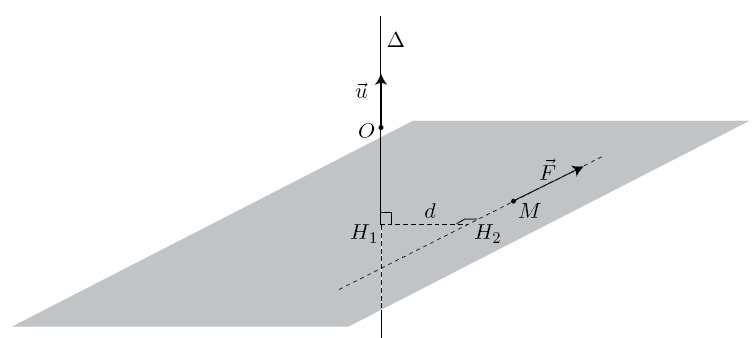
<p>Si  <math xmlns="http://www.w3.org/1998/Math/MathML" overflow="scroll">
    <mi mathvariant="bold">F</mi>
  </math> est perpendiculaire à <math xmlns="http://www.w3.org/1998/Math/MathML" overflow="scroll">
    <mi>&#x0394;</mi>
  </math> alors</p>
<math xmlns="http://www.w3.org/1998/Math/MathML" display="block" overflow="scroll">
    <msub>
      <mi>&#x2133;</mi>
      <mi>&#x0394;</mi>
    </msub>
    <mo>=</mo>
	<mfenced separators="">
	<mfenced separators="">
	<mi mathvariant="bold">O</mi>
	<msub>
      <mi mathvariant="bold">H</mi>
	  <mn>1</mn>
	</msub> 
	 <mo>+</mo>
	  <msub>
      <mi mathvariant="bold">H</mi>
	  <mn>1</mn>
	</msub>
	 <msub>
      <mi mathvariant="bold">H</mi>
	  <mn>2</mn>
	</msub>
	<mo>+</mo>
	  <msub>
      <mi mathvariant="bold">H</mi>
	  <mn>2</mn>
	</msub>
	      <mi mathvariant="bold">M</mi>
		</mfenced>
	       <mo>&#x2227;</mo>
      <mi mathvariant="bold">F</mi>
    </mfenced>
    <mi>.</mi>
    <mi mathvariant="bold">u</mi>
    <mo>=</mo>
    <mfenced separators="">
      <msub>
        <mi mathvariant="bold">H</mi>
        <mn>1</mn>
      </msub>
      <msub>
        <mi mathvariant="bold">H</mi>
        <mn>2</mn>
      </msub>
      <mo>&#x2227;</mo>
      <mi mathvariant="bold">F</mi>
    </mfenced>
    <mi>.</mi>
    <mi mathvariant="bold">u</mi>
    <mo>=</mo>
    <mo>&#x00B1;</mo>
    <msub>
      <mi>H</mi>
      <mn>1</mn>
    </msub>
    <msub>
      <mi>H</mi>
      <mn>2</mn>
    </msub>
    <mi>.F</mi>
    <mo>=</mo>
    <mo>&#x00B1;</mo>
    <mrow>
      <mi>F</mi>
      <mi>d</mi>
    </mrow>
  </math> 

<p class="centre"><img src="images/mecanique_moment_cinetique/moment_axe.png" alt="" /></p>


<h4>Moment cinétique par rapport à un axe</h4>
<p>La grandeur</p>

<math xmlns="http://www.w3.org/1998/Math/MathML" display="block" overflow="scroll">
    <mtable frame="solid">
      <mtr>
        <mtd>
          <msub>
            <mi>L</mi>
            <mi>&#x0394;</mi>
          </msub>
          <mo>=</mo>
          <msub>
            <mi mathvariant="bold">L</mi>
            <mi>O</mi>
          </msub>
          <mi>.</mi>
          <mi mathvariant="bold">u</mi>
        </mtd>
      </mtr>
    </mtable>
  </math>

<p>est appelée moment cinétique par rapport à <math xmlns="http://www.w3.org/1998/Math/MathML" overflow="scroll">
    <mi>&#x0394;</mi>
  </math> du point M.</p>

<h4>Théorème du moment cinétique par rapport à un axe</h4>
<p>Soit  <math xmlns="http://www.w3.org/1998/Math/MathML" overflow="scroll">
    <mi>&#x0394;</mi>
  </math> un axe <strong>fixe</strong> passant par O, de vecteur directeur <math xmlns="http://www.w3.org/1998/Math/MathML" overflow="scroll">
    <mi mathvariant="bold">u</mi>
  </math>. En projetant le théorème du moment cinétique suivant <math xmlns="http://www.w3.org/1998/Math/MathML" overflow="scroll">
    <mi mathvariant="bold">u</mi>
  </math> :</p>

<math xmlns="http://www.w3.org/1998/Math/MathML" display="block" overflow="scroll">
    <mtable frame="solid">
      <mtr>
        <mtd>
          <mstyle displaystyle="true">
            <mfrac>
              <mrow>
                <mi>d</mi>
                <msub>
                  <mi>L</mi>
                  <mi>&#x0394;</mi>
                </msub>
              </mrow>
              <mrow>
                <mi>d</mi>
                <mi>t</mi>
              </mrow>
            </mfrac>
          </mstyle>
          <mo>=</mo>
          <msub>
            <mi>&#x2133;</mi>
            <mi>&#x0394;</mi>
          </msub>
        </mtd>
      </mtr>
    </mtable>
  </math>

<p class="def">Dans un référentiel galiléen, la dérivée du moment cinétique par rapport à <math xmlns="http://www.w3.org/1998/Math/MathML" overflow="scroll">
    <mi>&#x0394;</mi>
  </math> par rapport au temps est égale au moment par rapport à <math xmlns="http://www.w3.org/1998/Math/MathML" overflow="scroll">
    <mi>&#x0394;</mi>
  </math> de la résultante des forces qui s'appliquent au point M.</p>


<div id="pied">
<hr />
<a href="../index.htm">accueil</a> >
<a href="../cours_de_physique.htm">matières</a> >
<a href="../cours_de_physique_rubriques/mecanique.htm">mécanique</a> > dynamique du point matériel en référentiel galiléen (suite)


<div id="xiti-logo">
<a href="http://www.xiti.com/xiti.asp?s=284918" title="WebAnalytics">
<script type="text/javascript">
<!--
Xt_param = 's=284918&p=mecanique_moment_cinetique';
try {Xt_r = top.document.referrer;}
catch(e) {Xt_r = document.referrer; }
Xt_h = new Date();
Xt_i = '<img width="39" height="25" border="0" ';
Xt_i += 'src="http://logv8.xiti.com/hit.xiti?'+Xt_param;
Xt_i += '&hl='+Xt_h.getHours()+'x'+Xt_h.getMinutes()+'x'+Xt_h.getSeconds();
if(parseFloat(navigator.appVersion)>=4)
{Xt_s=screen;Xt_i+='&r='+Xt_s.width+'x'+Xt_s.height+'x'+Xt_s.pixelDepth+'x'+Xt_s.colorDepth;}
document.write(Xt_i+'&ref='+Xt_r.replace(/[<>"]/g, '').replace(/&/g, '$')+'">');
//-->
</script>
<object>
<noscript>
<div id="xiti-logo-noscript">
<img width="39" height="25" src="http://logv8.xiti.com/hit.xiti?s=284918&amp;p=&amp;" alt="WebAnalytics" />
</div>
</noscript>
</object>
</a>
</div>


</div><!-- pied -->


</div>
<!-- page -->
</body>
</html>